Classroom stools: The Evolving Role of Classroom Stools in 2026
This guide covers everything about classroom stools. As of April 2026, classroom stools are no longer a novelty but a cornerstone of modern educational design. They represent a significant departure from traditional, static seating arrangements, embracing a philosophy of movement and engagement. This shift is driven by a growing understanding of how physical posture and flexibility directly impact a student’s ability to concentrate and learn.
Last updated: May 1, 2026
- Classroom stools in 2026 are integral to flexible seating, promoting student movement and engagement.
- They cater to diverse learning styles and physical needs, enhancing focus and collaboration.
- Choosing the right stool involves considering student age, classroom layout, and specific learning goals.
- Proper use and integration are key to maximizing the educational benefits of classroom stools.
The traditional classroom, with its rows of identical desks and chairs, often stifles the natural inclination of children to move. This can lead to restlessness, decreased focus, and a passive learning experience. Classroom stools, however, offer a dynamic alternative, empowering students to choose seating that best suits their immediate needs and learning style. This guide explores the complex world of classroom stools as of 2026, examining their benefits, types, selection criteria, and integration into effective learning spaces.
What Exactly Are Classroom Stools?
Classroom stools are essentially compact, backless seats designed specifically for educational environments. Unlike standard chairs, they often encourage a more active posture, allowing students to subtly shift their weight and maintain alertness. Many models are lightweight and stackable, offering practical advantages for classroom management and space utilization.
Their design prioritizes functionality and adaptability. You’ll find stools in a variety of heights, materials, and features, from simple, stable perches to more dynamic ‘wobble’ stools that engage core muscles. This variety ensures that educators can find options to suit different age groups, subjects, and pedagogical approaches.
Use Case Example: In a bustling kindergarten classroom, low, sturdy stools might provide a safe and accessible seating option for art activities. For older students in a science lab, adjustable, taller stools can facilitate comfortable observation at lab benches.
The Science Behind Active Seating
The move towards furniture like classroom stools is underpinned by emerging research in neuroscience and kinesiology. As of 2026, educators and designers increasingly recognise that physical activity, even subtle movement, is crucial for cognitive function. Sitting still for prolonged periods can lead to fatigue and reduced blood flow to the brain.
Active seating options, including many types of classroom stools, encourage micro-movements. These movements help maintain alertness, improve focus, and can even reduce fidgeting that distracts from learning. According to a 2025 study by the University of California, Berkeley, students using dynamic seating exhibited improved attention spans during complex tasks compared to those in traditional chairs.
Example: A student using a wobble stool might unconsciously engage their core muscles while listening to a lecture. This constant, low-level physical engagement can prevent the mental slump that often accompanies prolonged passive sitting.
Benefits of Integrating Classroom Stools
The advantages of incorporating classroom stools extend across academic, physical, and social domains. They are a key component in creating truly flexible learning environments that cater to individual needs and foster a more inclusive atmosphere.
Enhanced Focus and Engagement
Many educators report that students using stools, particularly wobble stools, show improved concentration. The ability to subtly move helps them stay alert and engaged, especially during longer lessons or independent work periods. This makes them valuable tools for students who struggle with traditional seating.
Support for Diverse Learners
Classroom stools offer a range of physical benefits. For students with sensory processing differences or ADHD, the ability to move and fidget in a controlled way can be calming and help them focus. Different stool heights and types allow students to find a comfortable, supportive position.
Improved Classroom Dynamics
The presence of flexible seating options like stools can foster a sense of autonomy and choice among students. This can lead to increased responsibility and respect for classroom resources. It also encourages collaboration, as students can easily reconfigure their seating for group work.
Space Efficiency and Flexibility
Many classroom stools are designed to be lightweight, stackable, or easily movable. This makes it simple for teachers to reconfigure the classroom layout for different activities, from whole-group instruction to small-group collaboration or individual study. This adaptability is crucial in modern, multi-purpose learning spaces.
Use Case Example: A teacher might clear a central area and have students bring their stools to form a discussion circle for a literature class, then easily move them back to individual work zones.
Types of Classroom Stools Available in 2026
The market offers a wide array of classroom stools, each designed with specific pedagogical goals and user needs in mind. Understanding these differences is key to selecting the right furniture for your educational setting.
Standard Fixed-Height Stools
These are the most basic type, offering a simple, stable seat at a fixed height. They are durable, cost-effective, and suitable for general use where dynamic movement isn’t the primary focus. Many have rubber feet to protect floors and prevent slipping.
Adjustable Height Stools
As their name suggests, these stools can be adjusted to various heights. This is crucial for accommodating students of different ages and sizes within the same classroom, or for pairing with different desk heights, including standing desks. Mechanisms vary, often involving a simple screw-lift or a gas-lift lever.
Wobble Stools (Active Seating Stools)
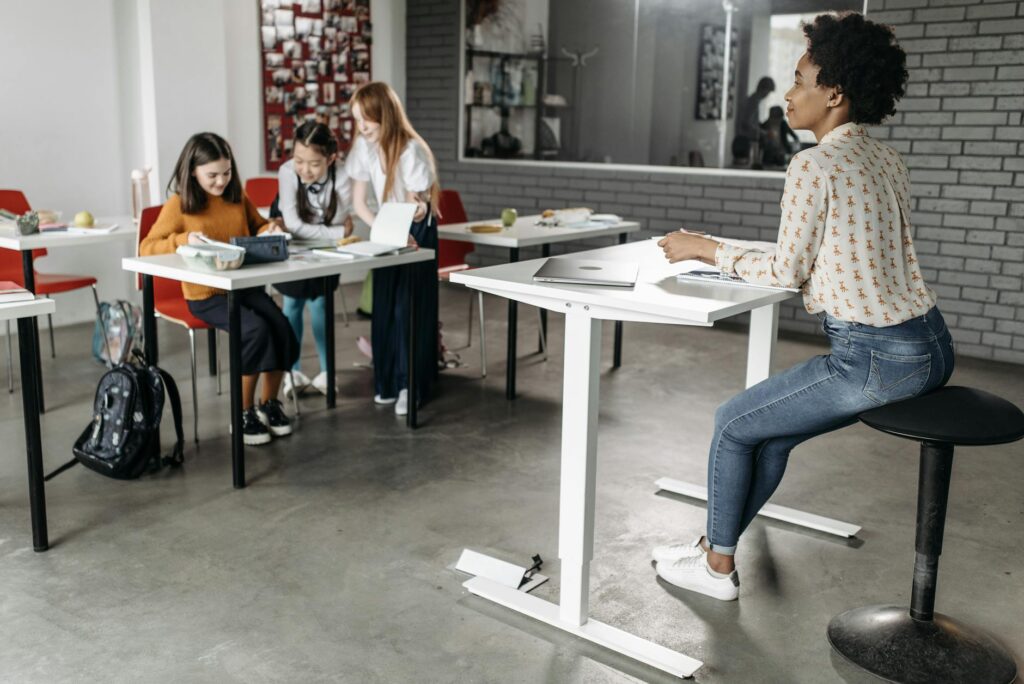
These are perhaps the most talked-about type of classroom stool in recent years. They feature a domed base that allows for 360-degree movement, encouraging core engagement and subtle shifts in posture. They are excellent for students who need to move to focus but can be too stimulating for some environments.
Example: The Haskell line of active seating, which includes stool-like options, demonstrates the trend towards furniture that actively supports posture and engagement.
Stool Desks / Sit-Stand Stools
These often combine a stool with a small work surface or are designed to be used at standing height desks. They offer a quick transition between sitting and standing, promoting variation in posture throughout the day. They are ideal for spaces with standing desks or for students who prefer to work at elevated surfaces.
Sensory Stools
Some stools are designed with sensory input in mind. This might include textured surfaces, gentle rocking capabilities, or materials that provide proprioceptive feedback. They are particularly beneficial for students with special educational needs or sensory processing challenges.
Choosing the Right Classroom Stools: A Practical Approach
Selecting appropriate classroom stools requires careful consideration of several factors. It’s not a one-size-fits-all decision, and what works for one class or school might not work for another. As of April 2026, many schools are developing complete flexible seating policies.
Age and Size Appropriateness
The most critical factor is ensuring stools are the correct height for the intended users. For younger children, lower, stable stools are essential. For older students or those using standing desks, adjustable or taller stools are necessary. Check manufacturer guidelines for age and height recommendations.
Durability and Material
Classroom furniture endures significant wear and tear. Opt for stools made from strong materials like sturdy plastic, metal, or solid wood. Consider ease of cleaning, especially for younger grades where spills are common. Anti-microbial surfaces are a plus in 2026’s health-conscious environment.
Safety Features
Ensure stools are stable and won’t easily tip over. For wobble stools, check that the range of motion is controlled and appropriate for the age group. Non-slip bases are crucial for all types. Avoid sharp edges or small parts that could be a choking hazard for younger children.
Classroom Layout and Space
Consider how the stools will fit into your existing classroom layout. Are they easily stored or stacked when not in use? Do they allow for clear pathways? Lightweight and stackable options offer the most flexibility for reconfiguring spaces.
Pedagogical Goals
What do you hope to achieve with these stools? If the goal is to increase movement and engagement, wobble stools might be ideal. If the aim is simply to provide alternative seating that’s easy to manage, stable, fixed-height stools may suffice. Alignment with teaching strategies is key.
Example: A teacher focused on project-based learning might choose a mix of stable stools for focused work and a few wobble stools for students who benefit from extra movement during brainstorming sessions.
Integrating Classroom Stools Effectively
Simply purchasing classroom stools isn’t enough; their successful integration into the learning environment requires thoughtful planning and clear expectations. It’s about creating a system where these tools enhance learning rather than becoming a distraction.
Establish Clear Guidelines
Students need to understand how to use the stools appropriately. Develop and communicate clear rules regarding movement, respecting personal space, and transitioning between seating options. For wobble stools, emphasize that they are for controlled movement, not play.
Offer Choice, Not Chaos
While choice is a benefit, it’s important to guide students. You might designate certain stools for specific tasks or times of day, or allow students to choose their seating after completing a certain responsibility. This prevents students from constantly switching and disrupting their focus.
Monitor and Adjust
Observe how students interact with the stools. Are they being used effectively? Are certain stools causing issues? Be prepared to adjust the number of stools, their placement, or the rules governing their use based on your observations. According to expert recommendations in educational design as of 2026, regular assessment is vital.
Combine with Other Flexible Seating
Classroom stools are often most effective as part of a broader flexible seating strategy. Complementing them with options like floor cushions, beanbags, standing desks, or traditional chairs allows for a wider range of choices and better accommodates all learners.
Use Case Example: A teacher might have a ‘choice chart’ showing available seating options. Students check off their choice for a work period, ensuring accountability and preventing overcrowding at any one type of seating.
Common Pitfalls to Avoid with Classroom Stools
While beneficial, the implementation of classroom stools isn’t without potential challenges. Being aware of common mistakes can help educators avoid disruptions and maximise the positive impact of this furniture.
Pitfall 1: Over-reliance on Wobble Stools
Problem: Assuming all students will benefit equally from highly dynamic seating. This can lead to distraction for some students who require more stability to focus, or for the class as a whole if not managed well.
Solution: Offer a variety of seating options. Use wobble stools strategically for students who demonstrably benefit from them, and ensure ample stable seating is available. Clearly define when and for whom dynamic seating is appropriate.
Pitfall 2: Lack of Clear Usage Rules
Problem: Students using stools for play or disruptive movement, leading to safety concerns and loss of focus. This often stems from a lack of explicit instruction on proper usage.
Solution: Dedicate class time to teach and practice the rules for using each type of seating. Reinforce expectations consistently and address misuse privately with students.
Pitfall 3: Inadequate Height Adjustment or Sizing
Problem: Providing stools that are too high or too low for students, leading to poor posture, discomfort, and reduced learning efficiency. This is common when stools are purchased without considering the specific age range or desk heights.
Solution: Measure students or consult manufacturer charts to ensure correct sizing. Prioritise adjustable-height stools when possible to accommodate a wider range of users and desk configurations.
Pitfall 4: Ignoring Classroom Space and Flow
Problem: Cluttering the classroom with too many stools or placing them in a way that obstructs movement and creates safety hazards. This can make transitions difficult and increase the risk of accidents.
Solution: Plan the classroom layout carefully. Choose stackable stools for easy storage. Ensure there are clear pathways and sufficient space around each seating area for students and the teacher to move freely.
Expert Insights for Maximizing Classroom Stool Impact
Beyond the basic understanding of types and benefits, there are nuanced strategies that expert educators and designers employ to truly harness the power of classroom stools. These often involve a deeper integration into the pedagogical approach.
The ‘Choice Menu’ Approach
Instead of open-ended choice, some educators implement a ‘choice menu’ for seating. This might involve students selecting from 2-3 pre-approved options for a given activity, based on their learning needs and the task at hand. For instance, focused reading might be best done on a stable stool, while brainstorming could use wobble stools.
Linking Movement to Learning Objectives
Expert practice involves intentionally connecting the use of active seating to specific learning goals. For example, a teacher might say, “For this math problem-solving session, I want you to choose seating that helps you focus. Try a stable stool or a wobble stool if you feel you need to move to think.” This frames movement as a tool for learning, not just a privilege.
Creating ‘Movement Zones’
In larger classrooms, designated ‘movement zones’ can be established. These areas might feature a cluster of wobble stools or standing desks. Students who benefit from movement can opt to work in these zones, while others can choose quieter, more traditional spots. This manages potential distractions while still offering choice.
Unique Insight Not Commonly Found: Some forward-thinking schools are experimenting with ‘active learning pods’ where furniture is modular and easily reconfigured. Classroom stools are central to these pods, allowing quick transitions from individual focused work to collaborative problem-solving simply by rearranging the stools and small tables.
Utilising Stools for Specific Skills Instruction
Consider using stools for specific instructional purposes. For instance, during writing workshops, individual stools placed around a central facilitator can create an intimate setting. For collaborative art projects, stools can be easily arranged around low tables, promoting easy interaction.
As noted by the Education Week Research Centre in early 2026, the most successful flexible seating implementations are those that are deliberately designed and consistently managed, rather than being an afterthought.
The Role of Ergonomics Beyond Posture
While posture is key, ergonomics also extends to the cognitive load. A stool that allows a student to comfortably shift their weight reduces physical distraction, thereby reducing cognitive load and freeing up mental resources for learning. This is a subtle but powerful benefit.
Frequently Asked Questions about Classroom Stools
Are classroom stools appropriate for all age groups?
Yes, classroom stools can be adapted for all age groups, from preschoolers to high schoolers. The key is selecting the correct height, stability, and type of stool to match the developmental needs and physical characteristics of the students.
How do I choose the right height for classroom stools?
Measure the typical desk or table height in your classroom. The stool height should allow students to have their feet flat on the floor with their knees at roughly a 90-degree angle, and their forearms parallel to the desk surface when working.
What is the difference between a wobble stool and a regular classroom stool?
A regular classroom stool offers a stable, backless seat. A wobble stool, also known as active seating, has a domed base that allows for 360-degree movement and encourages core engagement and subtle posture adjustments.
Are classroom stools safe for students?
When chosen appropriately and used with clear guidelines, classroom stools are safe. Stability, non-slip bases, and controlled movement ranges (for wobble stools) are essential safety considerations. Proper instruction on usage is also critical.
How many classroom stools do I need?
The number depends on your classroom size, student count, and pedagogical approach. Many teachers opt to have enough stools to offer choice, often for 30-50% of the class, integrating them with other seating options.
Can classroom stools help students with ADHD?
Many students with ADHD find that the ability to move subtly while seated on a stool helps them maintain focus and manage restlessness, making it a beneficial seating option for them.
Conclusion: Embracing Dynamic Learning with Classroom Stools
Classroom stools in 2026 are far more than just furniture; they are powerful tools for fostering active, engaging, and adaptable learning environments. By understanding the diverse types available, carefully considering selection criteria, and implementing them with clear intention and management, educators can unlock significant benefits for student focus, well-being, and academic success.
Actionable Takeaway: Evaluate one specific learning activity in your classroom and identify how introducing a choice of classroom stools could enhance student engagement and focus for that particular task.
Editorial Note: This article was researched and written by the Class Room Centre editorial team. We fact-check our content and update it regularly. For questions or corrections, contact us. Knowing how to address classroom stools early makes the rest of your plan easier to keep on track.